
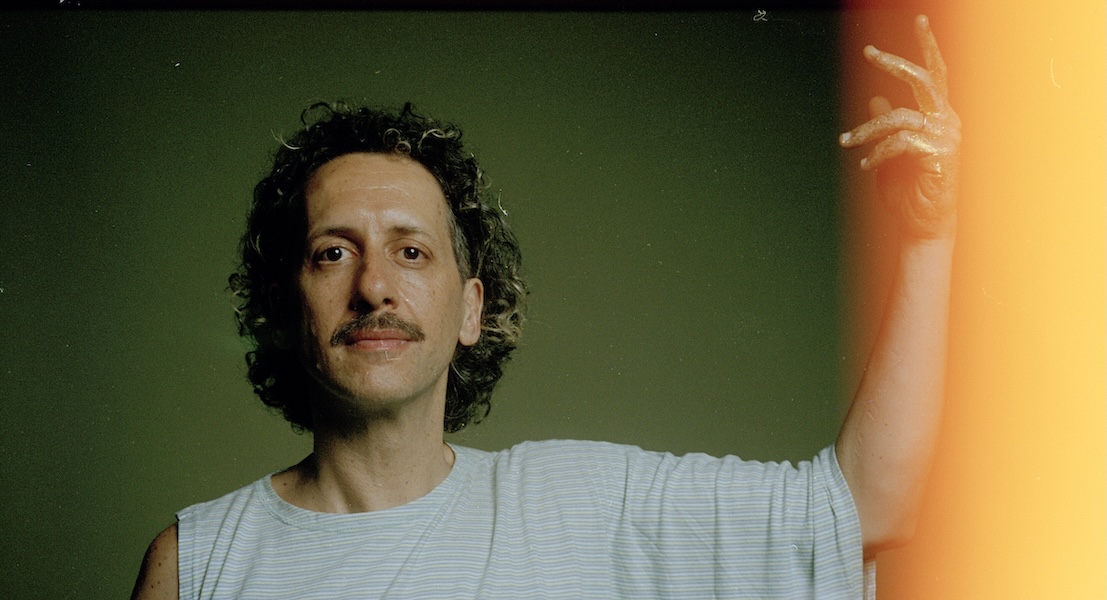
Rooted in the boundless musical traditions of Brazil and shaped by a life spent exploring sounds across continents, Caetano Malta has spent over three decades carving out a distinctive creative identity. Blending MPB, Tropicalia, Afro-Brazilian rhythms, and psychedelic influences, his music reflects a world without borders, where cultural exchange and instinctive experimentation go hand in hand.
Now stepping into a new chapter with his debut solo album, ‘Eterna Juventude,’ released via Favorite Recordings, Malta turns inward, drawing on childhood memories and the birth of his daughter to explore imagination, joy and the art of living in the moment.
Now based in Paris, with São Paulo forever at the heart of his sound, he joins us to discuss the experiences, collaborations, and musical discoveries that have shaped his journey so far.
WWD: How does growing up in São Paulo continue to shape your musical identity today?
I lived in São Paulo for 38 years and I try to go back twice a year. I follow current Brazilian music closely and am deeply connected to Brazilian culture, so that influence never stops.
When I was a child, my father played a lot of MPB at home; later, with my brothers and friends, I got into national and international rock. But it was by playing with artists from all over Brazil that I consolidated my identity. All of Brazil is inside São Paulo, so I had the opportunity to play with incredible people from across the entire country. The first artist I started playing with in 2005 was Wado from Alagoas; later I met MOMO from Rio de Janeiro; I started playing with Lucas Santtana from Bahia, with Buhr from Recife, with several female singers from Belém do Pará, and so on. São Paulo is endless.
WWD: Your work blends Tropicalia, MPB, Afro Brazilian rhythms, psychedelic folk and contemporary pop. Where do you see yourself within the broader Brazilian musical lineage?
Brazilian music has no borders, and that borderless world is precisely where I live. At the same time, Brazilian music is so strong within me that even if I try to make a Congolese rumba, it will always sound Brazilian. Mixtures are very natural and allowed in Brazilian music. My music is like a chef who has travelled to many places, brought back many spices and ingredients, and invents their own dishes while always keeping their regional accent.
WWD: After more than twenty years of collaborations and touring, what feels most uniquely yours about your sound now?
What I feel is uniquely mine is my Congolese rumba from Bahia, my psychedelic afoce and my fuzz MPB ska.
What inspired the theme of youthfulness and imagination in ‘Eterna Juventude?’
My greatest inspiration for this album was the birth of my daughter. Afterward, I started accessing various memories from my childhood and ended up having a few insights. My theory is that the wisdom of happiness lies in the mind of a child. When we recall the fond moments of our childhood and when we play with children, we manage to access that feeling. That was the exercise I practiced while making the record. In Portuguese, we have the verb brincar, which is different from jogar to compete or play a game. Brincar means to play without any intention of winning, it is playing purely to have fun, surrendering oneself to a world of imagination, fantasy and enjoyment. It is the child’s way of knowing how to live, being happy through imagination alone. That is the core of Eterna Juventude.
WWD: How did you approach balancing harmonic sophistication with the simplicity of instantly memorable melodies?
I believe that melodies are always floating around us; if our channels are open, we can receive them. Most of my songs start this way, catching a melody out of the air, so almost everything sounds very natural. Afterward, intellectual work is almost always required to develop and finish a composition. Sometimes harmony and melody come together, but I never think about complicating harmonies; every now and then, though, the melody demands a more complex harmony. I always try to maintain a sense of originality, and I think that can lead to unexpected harmonic paths.
WWD: Was there a particular moment or experience that set the emotional direction of the album?
Yes. The birth of my daughter, the process of remembering my childhood, and the insights I mentioned earlier.
WWD: Which track on ‘Eterna Juventude’ feels like the heart of the album for you, and why?
I think Estrela, because I composed it for my daughter, and it features a mix of styles that I love, MPB, Congolese rumba and progressive rock.
WWD: When you begin a new piece, which role leads the way for you, singer, songwriter or multi instrumentalist?
Usually the songwriter, but most songs begin through the voice, with a melody.
WWD: What do you think about the relationship between melody and harmony when writing?
The melody is usually the leader; the harmony serves as clothing for the melody.
WWD: Which rhythmic ideas or traditions were most influential during the making of this album?
There is not one specific tradition or rhythm; Brazil has an immense number of musical styles, and many of them are present on the record. But there is one I hold a special affection for, afoce, especially when mixed with a dose of psychedelia.
WWD: Did any specific instrument become central to shaping the album’s identity?
Yes, my old Del Vecchio nylon string guitar.
WWD: How have your collaborations with Lucas Santtana, Wado, MOMO, Rubinho Jacobina, Arto Lindsay and others influenced your evolution as a songwriter?
Those collaborations taught me a lot. When I compose in partnership, I somehow learn and absorb the other person’s technique, sometimes their way of searching for or following through on an idea. My most frequent partner is MOMO; we have been collaborating for over 20 years. Wado, my first partner, was the one who introduced me to MOMO. I have been on stage with Lucas Santtana for 15 years, and watching his creative process album after album, I learned a lot. Rubinho is also a great master with whom I had the pleasure of composing several songs; his way of seeking ideas is unique and very natural, which also changed my way of writing. Arto was the first time we collaborated, which was a great honor for me.
WWD: What did performing with artists like Flavia Coelho, Luiza, Guts and Bixiga 70 teach you about your own musical voice?
Each artist taught me something different, but all of them taught me to value my own art, especially because there is a mutual admiration. They taught me to believe in the project and work hard, because even for great artists, nothing comes for free or by chance.
WWD: Are there any subtle collaborative fingerprints on ‘Eterna Juventude’ that listeners might not immediately notice?
Yes. On Domingo Matine, Mauricio Fleury ex Bixiga 70 recorded and arranged the flute and glockenspiel. And on Infinito Vao, Fabio Pinczowski recorded and arranged the synthesizers.
WWD: How has living in Paris reshaped your creative process after years of touring internationally?
Paris did not exactly reshape my creative process, which is deeply tied to Brazil. Living in France brought me great opportunities and immensely expanded my network of contacts, which always helps. Later, through France, I discovered some styles of African music, and that enriched me immensely, ultimately transforming my music.
WWD: What do you carry from São Paulo and Paris respectively when you make music?
From São Paulo, almost everything, since I lived most of my life there. From Paris, Congolese rumba.
WWD: Has distance from Brazil changed the way you relate to Brazilian musical traditions?
Yes, the distance from Brazil strengthened my connection to Brazilian music and reinforced my Brazilian identity. Not necessarily with traditional music, but with the way of making music, with the creativity and freedom that exist in Brazilian culture.
WWD: What drew you to releasing your debut solo album with Favorite Recordings?
Favorite Recordings appeared as the perfect label. They loved my music and made a great offer. We have mutual friends, and they have an excellent reputation. We share the same tastes and get along very well. A great partnership.
WWD: How do you see ‘Eterna Juventude’ fitting into the Brazilian thread within Favorite’s catalogue?
I see it as a rare gem ready to be discovered in record stores around the world.
WWD: How did Favorite’s emphasis on analog warmth and high quality mastering influence the final sound of the album?
Favorite handled the mastering for vinyl with Frank Merritt at Carvery Studios in London. Frank added a nice dose of compression that warmed up the sound. The beautiful vinyl pressing ordered by Favorite brought all that analog sound to life. The vinyl sounds incredible.
WWD: What does releasing your first solo album represent for you personally and artistically?
It represents an immense achievement and the consolidation of a long journey of over 35 years in music, but also something very natural and inevitable. It also represents opening a new door to a sea of possibilities, the chance to perform and travel with this album, to share my music around the world, and to delight people with the energy and magic of Eterna Juventude. I am very excited.
WWD: What do you hope listeners feel the first time they hear ‘Eterna Juventude?’
I hope they feel a connection to Universal Love, I hope they feel light and emotion, and that they can connect without fear to the child and the childhood memories within them. In the end, I hope they start playing brincar more.
WWD: Where do you see your music heading after this album?
I see my music playing on the radio and myself traveling with my friends to move people around the world. I see myself making many albums in my studio in São Paulo with various talented musicians, but also here in France with incredible people I know and have yet to meet. I see an immense creative universe ahead of me.
WWD: Sounds amazing! Thanks for the chat 🙂
‘Eterna Juventude’ is available here