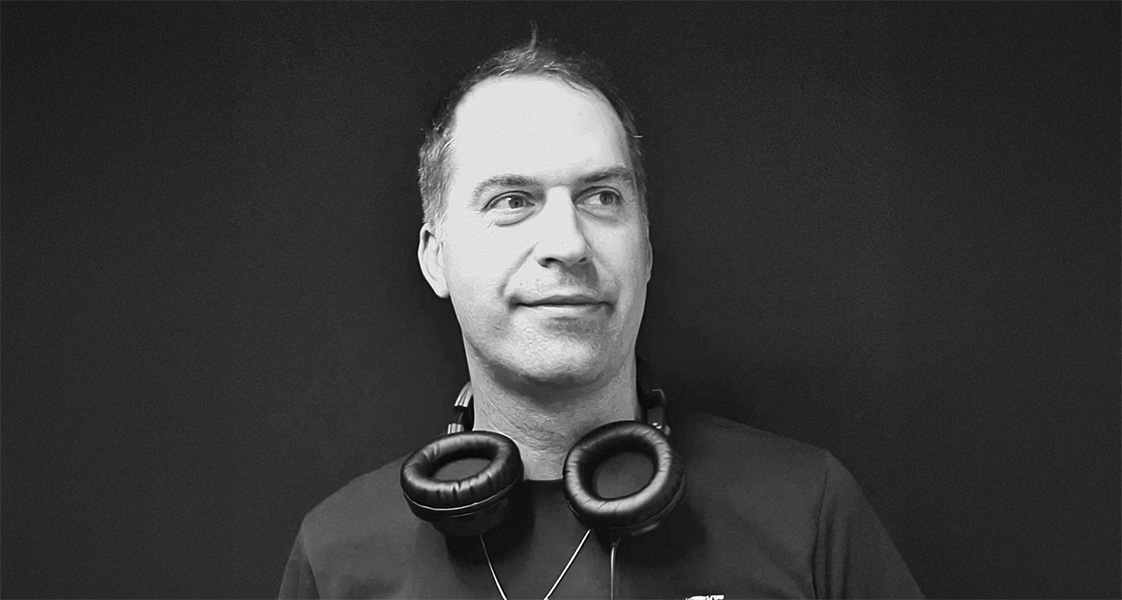
London-based DJ and producer DJ Meoz crafts Progressive House with a cinematic edge, blending the raw pulse of 90s Techno with the emotional depth of the early 2000s electronic wave. With a background rooted deeply in the art of DJing before stepping fully into production, his sound is built on storytelling — structured with the precision of a selector and shaped with the atmosphere of a world-builder. Fresh off the release of ‘Ancient Legend’ on Polyptych Limited, we caught up with him to talk about dual musical DNA, tension and release, and the mythic undercurrent running through his evolving discography.
WWD: You grew up on 90s Techno and the early 2000s electronic wave – when you look back, what do you think those eras gave you that still shapes your sound today?
Growing up on 90s Techno and the early 2000s electronic wave gave me a kind of dual DNA. The 90s taught me the power of raw energy, that hypnotic, driving pulse that doesn’t need anything fancy to move you. It was all about atmosphere, tension, and that almost ritualistic repetition. Then the early 2000s arrived and suddenly the sound became more emotional, more melodic, more cinematic. Producers were experimenting with texture, storytelling, and this sense of futurism that felt limitless. Those two eras together shaped how I approach music today: raw groove at the core, cinematic feeling around it.
WWD: Before production, you were deeply focused on mastering the art of DJing. How did those years of studying radio shows and mixtapes shape the way you now approach building a track?
Those years trained my ear before anything else. Studying radio shows and mixtapes taught me how to read energy, how to pace a journey, and how every transition needs a purpose. Now, when I build a track, I think like a DJ first — structure, tension, release. It’s the same storytelling, just from the other side of the booth.
WWD: You formally stepped into music production in 2019. What shifted for you at that point?
I actually started using a DAW many years before 2019, but for personal reasons I had a long break and kept it mostly as a hobby. In 2019 something shifted, I finally felt ready to take it seriously. It wasn’t about discovering production, it was about deciding to step into it with intention and build my own sound.
WWD: Your latest release ‘Ancient Legend’ on Polyptych Limited White carries a strong sense of atmosphere and forward motion. What was the initial spark behind this record?
The initial spark was actually a production idea. I was experimenting with a rolling low‑end pattern that felt like it was pushing forward on its own, almost like a moving engine, like a march. From there I started shaping the atmosphere around it: long‑tail reverbs, filtered textures, and a lead that evolves subtly rather than taking over. The concept of an “ancient force” came later, once the groove and sound design already had that sense of momentum. The track grew from that interplay between motion and space.
WWD: There’s something quite cinematic about the title. What does ‘Ancient Legend’ represent to you personally?
Personally, ’Ancient Legend’ isn’t about a specific story, it’s more like a feeling that’s been with me for years. The title represents those inner myths we all carry, the things that shape us even when we don’t fully understand them. When I was building the track, that sense of something old, quiet, and powerful kept coming back. ’Ancient Legend’ is my way of giving sound to that presence,not explaining it, just letting it move.
WWD: Progressive House often sits in that space between restraint and release. How do you balance emotional depth with dancefloor energy when you’re producing?
For me it’s all about tension management. Progressive House lives in that space where emotion and energy have to coexist, so I build my tracks with both in mind from the first sketch. I shape the groove to be functional and steady, but I let the melodies and textures breathe above it using slow‑evolving layers, subtle modulation, small details that carry feeling without killing the momentum. It’s a balance of architecture and intuition: the dancefloor gets the engine, the emotion lives in the atmosphere around it.
WWD: Looking at your recent run of releases — from ‘Seasons | Winter 2026’ to collaborations like ‘Rite of Passage’ – it feels like you’re exploring different shades of storytelling. Do you see your discography as chapters of the same narrative, or separate worlds?
I see them as connected, but not in a linear way. Each release feels like its own world, with its own mood and symbols, yet they all come from the same place in me. ’Seasons | Winter 2026,’ ’Rite of Passage,’ ’Ancient Legend’ — they’re different shades of the same instinct to tell a story through the sound. So it’s less a single narrative and more a constellation of chapters that speak to each other.
WWD: How different is DJ Meoz in the studio versus DJ Meoz behind the decks? Is there a contrast between the introspective producer and the live performer?
There’s definitely a contrast. In the studio I’m more introspective. I’m chasing details, building worlds, following ideas that don’t need to make sense to anyone but me at first. Behind the decks it’s the opposite: it’s instinct and connection with the dancefloor in real time. In the studio I disappear into the sound; on stage I translate that inner world into energy that I hope people can feel, and then there’s a third DJ Meoz: the one who loves partying across Europe whenever I can. That side feeds the other two; it keeps me inspired, curious, and connected to the culture that shaped me.
WWD: Being London-based, how much does the city influence your sound? Does the environment seep into your music consciously or subconsciously?
London definitely seeps into my music, but mostly in a subconscious way. The city has this mix of intensity and anonymity, constant movement, late‑night atmospheres, and a sense that something is always happening just out of sight. That energy filters into my sound design and pacing. I don’t sit down thinking “I’m going to make a London track,” but the environment shapes the mood, the tension, and the way I build space inside a groove.
WWD: When you’re building a set around your own productions, do you design the journey first or do you let the crowd dictate where the story goes?
When I’m playing my own productions, I always have a loose journey in mind, a kind of emotional arc I want to create. But once I’m in the booth, the crowd becomes part of the equation. I let their energy decide how far I push it or when to shift direction. So I build the framework, but the story only really takes shape when the room responds.
WWD: If you could go back and give your younger self one piece of advice when you were obsessively studying mixtapes, what would it be?
I’d tell him to trust the process a bit more. All those hours obsessing over mixtapes were already shaping my instincts, even when it didn’t feel like progress. I’d remind him that the patience, the curiosity, and the deep listening would eventually become part of his sound and that it’s okay to take the long way around.
WWD: If ‘Ancient Legend’ were the opening scene of a film, what would we see?
If ’Ancient Legend’ opened a film, it would begin in near‑darkness: a single ancient symbol glowing faintly on stone. The air vibrates, dust shifts, and then that distant, chant‑like vocal rises, not as a melody, but as an invocation. It feels like a forgotten ritual being remembered, a call awakening something that has been silent for centuries.
WWD: Beautiful! Thanks for the chat 🙂
Thanks!
‘Ancient Legend’ is available here.