
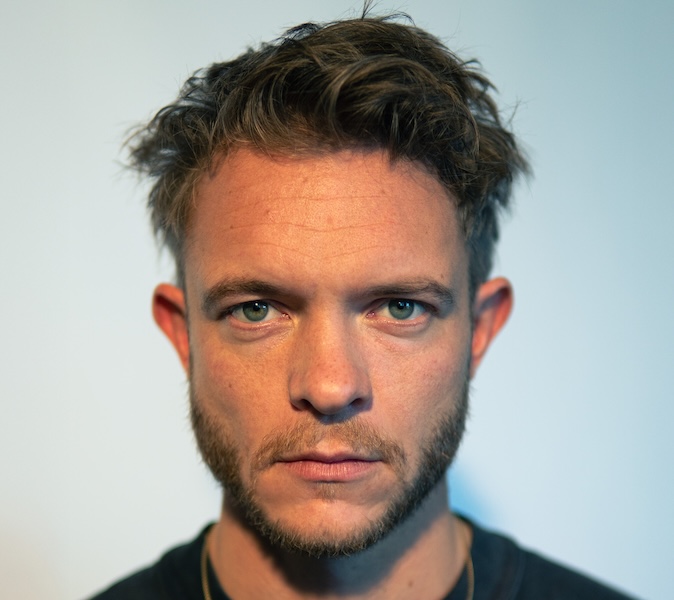
Darksidevinyl returns to Yoshitoshi with ‘U R’ and ‘Save Me’ – a release written in isolation in front of the mountains, layering real feeling alongside technical polish.
Founded over thirty years ago by Grammy-winning duo Deep Dish (Sharam and Dubfire), Yoshitoshi has shaped house and techno with genre-defining classics and a reputation built on quality over hype. Now steered solely by Sharam, the label is in the middle of a celebrated return to form, and Darksidevinyl has become one of its most consistent voices along the way.
We caught up with the Egypt-born, Greece-based artist to talk isolation and songwriting, his growing history with the imprint, and why you’ll never catch him behind a laptop on stage.
WWD: Welcome back to When We Dip – how’s life in Greece treating you, and how does it compare creatively to the Vienna years before it?
It’s beautiful, but honestly, it took me a long time to adjust because Greece completely deconstructed my internal clock. In the city, you measure life by deadlines and schedules; out here, you measure it by light, weather, and silence.
Creatively, it has been a total rebirth compared to my years in Vienna. Vienna was all about architectural structure and urban pressure. It was an essential chapter, but it was filled with this fast-paced, industrial friction that forced me to create from a place of survival and defense. The music had to be loud to compete with the city’s noise.
Greece stripped away that armor. Being isolated in nature gave me an immense, almost intimidating sense of space that I had never experienced before. At first, the silence was deafening. But then it taught me to stop forcing the music. In Vienna, I was chasing the track; in Greece, I am just sitting still and letting the sound arrive on its own terms. It moved me from a calculated, tense way of producing to something entirely raw, peaceful, and purely intuitive.
WWD: ‘U R’ was written in isolation in front of the mountains – what pulled you out there, and how much of that physical isolation actually ended up in the record?
For me, going out there wasn’t a calculated decision. I don’t really believe I choose my destinations; rather, I feel God guided me to where I need to be to discover who I am. Every experience carries its answers, but you only get to read them once you reach the end of the road.
When I sit in front of mountains that have existed for millennia, my own existence suddenly feels very small, yet incredibly clear. That physical isolation forced me to strip away all the noise of daily life and look inward. The track became a direct mirror of that quietness. When I finally found the expression for what I was feeling inside, I realized I didn’t want anything in return from the music. There was no expectation of success, no pressure to fit into a specific club scene, and no desire for validation.
That is exactly why the record is called “U R.” It is about a pure state of being, acceptance, and presence. I wanted to capture that raw, uncompromised honesty so that when people listen to it, they don’t just hear a track, they feel that same space, that same freedom to just exist without needing to explain themselves to the world.
WWD: Both tracks carry real emotional weight without losing dancefloor function. Where’s the line for you between a track that moves a room and one that moves people emotionally – and how do you keep both alive in the same three minutes?
For me, there shouldn’t be a line between the two; the body and the soul are not separate. A dancefloor isn’t just a physical space, it’s a collective room where people go to release, to escape, or to find something within themselves. The groove, which is the functional rhythm, is what anchors you to the floor, but the emotion is what elevates you.
If a track only moves the body, it’s just a passing rhythm. If it only moves the mind, it loses its communal power. Keeping both alive at the same time is all about balance. It’s about using the repetitive, hypnotic nature of electronic music to lower the listener’s guard, so that when the emotional chord or melody finally hits, it strikes much deeper. It’s about turning the dancefloor into a space for introspection
WWD: ‘Save Me’ is the flip side to ‘U R’ – were the two written as a pair, or did they only become a single story once you looked at them together?
They were absolutely written as a pair, because to me, they represent two halves of the same journey. You can’t fully understand one without experiencing the other; they are the completion of a single story.
If “U R” is about finding that raw, solitary presence in front of the mountains discovering who you are when everything else is stripped away then “Save Me” is the natural continuation of that awakening. It is the realization that once you find yourself, you have to bring that truth back into the world and face your vulnerabilities.
I didn’t write them as separate projects that just happened to fit together later. From the very beginning, the creative process felt like balancing a scale. One track looks inward, while the other looks outward, reaching for salvation and connection. Together, they close the circle, telling a complete story of isolation, self-discovery, and ultimate surrender.
WWD: What’s the one production choice on this release you almost didn’t make, but kept?
It was the raw integration of the main vocal over that heavy, deep bass synth. Originally, when I paired that driving analog synth with the dense layers of drums and percussion, the groove felt incredibly powerful on its own, almost complete as a pure club tool. I hesitated for a long time about introducing the vocal because I was afraid it might overwhelm the track or break the hypnotic rhythm of the percussion.
For a moment, I almost stripped it back to keep it safe and strictly instrumental. But then I realized that the vocal was exactly what gave the track its human heart and vulnerability. Keeping that deep bass synth and the raw analog texture rubbing directly against the emotion of the vocal created this beautiful, tense friction. It was a risky choice because balancing those heavy low frequencies with a delicate human voice is always a production challenge, but keeping it in was what ultimately gave the record its soul.
WWD: What does it mean to be one of the artists carrying Yoshitoshi’s comeback forward?
To be a part of the legacy of Yoshitoshi Recordings right now feels less like a corporate milestone and more like a profound learning experience and responsibility. When you look at the history of electronic music, Yoshitoshi is an absolute institution that helped define the underground landscape for decades. Being trusted to contribute to its modern chapter as a producer means honoring that rich, historical foundation of deep dancefloor music while carefully sharing my own story.
For me, it’s about contributing to a legacy built on raw authenticity. Yoshitoshi has always been a home for records that carry real substance, atmosphere, and longevity, rather than short-lived trends. Bringing my own identity into that ecosystem fusing my personal melodies with a deeper club edge is something I approach with a lot of respect. I am simply grateful to be one of the many artists helping to keep the label’s timeless underground spirit alive for the next generation of listeners.
WWD: You’ve now released ‘Red Face / Black Shine,’ ‘Color Of Love / Shadow Master,’ and ‘U R’ on the label. How has your relationship with Sharam and the imprint evolved release to release?
It has evolved into something much deeper than just a professional partnership; Sharam and the whole Yoshitoshi team have really become family to me.
When you first sign to a label as iconic as this, you naturally feel a certain level of pressure and distance. But with every release from Red Face / Black Shine to Color Of Love / Shadow Master and now U R that barrier completely melted away. Sharam didn’t just look at me as a producer delivering tracks; he invested time in my growth, acting as a mentor who truly understands my artistic language. He creates a space where I can be completely vulnerable and experimental with my sound, without the fear of being judged or forced into a commercial box.
Today, when I send over new music, it feels like sharing a piece of my life with family. There is total trust, mutual respect, and a shared vision for keeping the raw underground spirit alive. They believe in my journey as much as I do, and that kind of creative safety net is rare and invaluable for an artist.
WWD: Is there something about the label’s open-mindedness that made it the right home for a sound that fuses Afro rhythms with progressive melody?
Absolutely. Yoshitoshi has never been a label that locks itself into a single genre box [Yoshitoshi Recordings], and that historic open-mindedness is exactly why it became the perfect canvas for my sound.
If you look back at their catalog, they have always embraced house music that carries rhythm, drama, and deep hypnosis. When I began fusing the raw, organic pulse of Afro rhythms with the sweeping, emotional soundscapes of progressive melody, I wasn’t sure how the industry would react. It’s a delicate balance; you are mixing the grounding, physical energy of the drums with the expansive, introspective storytelling of the melodies.
Sharam and the label didn’t try to clean up that friction or make it fit into a safer, more predictable formula. They immediately understood that the magic lives exactly in that contrast. They gave me the absolute freedom to bridge these two musical worlds, trusting that a dancefloor can be both deeply spiritual and intensely physical at the same time.
WWD: You’ve built your whole stage identity around not DJing – vinyl and live percussion, real-time improvisation. What was the moment you decided a normal set wasn’t going to cut it for you?
For me, it wasn’t a sudden choice, it was an awakening rooted in who I am. I’ve been a vinyl DJ since 1999 , and I am, at my core, a percussionist. For over two decades, my relationship with music has been strictly physical.
The moment a normal set stopped cutting it for me was when I found myself standing behind a modern digital setup and felt completely numb. After years of touching the groove on a record and physically striking a drum, looking at a digital screen felt like staring at an empty void. There was an artificial wall between my hands, my feelings, and the crowd. I realized that if I can’t feel the vibration of the sound in my own bones, I cannot expect the dancefloor to feel it either.
That is why I had to bring my two worlds together on stage. When I play vinyl, I am connecting with the physical weight, the warmth, and the beautiful imperfections of the music. When I play live percussion, I am injecting my actual heartbeat into the room in real time. It allows me to improvise, to feel the exact mood of the crowd, and to translate my internal emotions into raw rhythm instantly. I didn’t step away from standard DJing to be different; I did it because my hands needed to touch the music again to make it real.
WWD: If every performance really is unrepeatable, does that change how you write music in the studio – are you already thinking about how a track will mutate live before it’s even finished?
Yes, absolutely, but not in a technical way. For me, it comes back to the fact that every shred of inspiration I have is drawn directly from the audience; without them, my music simply wouldn’t exist.
When I am in the studio, I am not just looking at a computer screen. I can already see the track in my head before I even touch the equipment, visualizing how it will move a room full of people. I envision the energy, the hands in the air, and the specific moment of connection. Yet, at the same time, some of the most profound elements come from completely nothing. It’s like a sudden spark of pure intuition that demands to be captured.
Because I view a track through the lens of the crowd, I deliberately leave space in the arrangement for it to mutate. I don’t over-produce or crowd the track with fixed digital layers. I leave those open gaps because I know that when I stand on stage with my vinyl and percussion, the audience will fill those spaces with their energy. The studio version is just the foundation; the track only truly finishes its story when it blends with the unrepeatable emotion of the people on the floor.
WWD: Is there a night where the improvisation completely ran away from you – for better or worse?
Honestly, I don’t view it as the improvisation running away from me, because I believe every single experience on the dancefloor has a purpose. Over the years, I have lived through almost every possible scenario on that floor: the perfect nights, the chaotic ones, the moments where technical things fail, and the moments of pure euphoria.
All of those experiences together are what gave me my education. They taught me how to read a room and understand the people in front of me on a deeper level. Because of that, when an improvisation takes an unexpected turn, I don’t panic or feel like I’ve lost control. I don’t see it as a mistake; I see it as the room telling me it needs something else.
If a rhythm shifts or a transition goes wild, I use that energy. That complete exposure to the unpredictable nature of the dancefloor is exactly what shaped my intuition. It made me realize that you can’t fight the room; you have to surrender to it. Every unpredictable night, for better or worse, was just another necessary lesson that taught me how to truly listen and connect.
WWD: You started producing in Cairo in 1998 and built the Afro-Progressive sound from there before it had international ears on it. Looking back, what were you actually reaching for at the time – did you know it was Afro-Progressive, or is that a name that got put on it later?
Back in 1998, I wasn’t thinking about genres or labels at all. In fact, I only really believe in one genre: good music. It doesn’t matter to me if people call it melodic, deep, tech, minimal, or Afro. If a track has soul and moves people, that is all that matters. The name ‘Afro-Progressive’ is definitely a label that came much later from the outside.
At the time in Cairo, I was just making what felt natural to my upbringing. There is a common misconception outside our region that Egypt is strictly Arab. But geographically and historically, we are African. We speak Arabic, and we have our own distinct languages, history, and unique accent, but we are Africans at our core. Because of that heritage, rhythm isn’t something we have to study or learn we are born with it directly in our blood.
So when I started producing, I wasn’t trying to invent a new style or follow a global trend. I was simply translating the natural polyrhythms of my surroundings and my African roots into electronic music. I was reaching for an authentic expression of who I am. The music industry always feels the need to put things into neat boxes and give them names, but for me, it was always just about creating honest music that carried our native pulse.
WWD: From Cairo, to Vienna, to Greece now – how much of Darksidevinyl sound is geography, and how much would sound the same no matter where you were living?
Geography definitely shapes the texture of my music, but it doesn’t change its soul. If you look at my journey from the ancient, rhythmic pulse of Cairo, to the intense urban friction of Vienna, and now to the vast silence of Greece, each place has gifted me a different color palette. Cairo gave me the raw rhythm in my blood, Vienna gave me structural tension, and Greece gave me the space to let it breathe.
But at the core, the essence of the Darksidevinyl sound would remain exactly the same no matter where I lived. That essence is driven by my internal world, my emotions, and my personal search for self-discovery. Geography simply dictates how those feelings are dressed.
In the city, the music might sound sharper and more compressed because of the surrounding concrete. In the mountains, it becomes more expansive and cinematic. But the underlying heartbeat of that deep, hypnotic conversation between human emotion and raw percussion is something I carry within me. I don’t make music to reflect a specific map; I make music to reflect a state of being, and that transcends any physical border.
WWD: ‘Another Brick In The Wall’ hitting #1 on Beatport’s Afro House chart is an interesting kind of landmark – reinterpreting Pink Floyd inside a genre you were still helping define. Does that track feel like it belongs to the same artist making ‘U R’ today, or a different one?
It definitely belongs to the same artist, because both tracks are driven by the exact same instinct: the desire to break boundaries and find freedom. Having that remix hit #1 on Beatport was a beautiful landmark, but it was never about chasing a chart position. It was about taking a legendary anthem that represents rebellion and free thought and translating it through my own African roots.
The artist who made that remix is the exact same artist making ‘U R’ today. The only difference is the stage of the journey. When I worked on ‘Another Brick In The Wall,’ I was using that driving, familiar structure to bridge worlds and push a sound forward. Today, with ‘U R’ I don’t need a massive, familiar hook to tell my story. The isolation in the mountains taught me to trust my own silence and my own raw melodies.
At the end of the day, both tracks are about stripping away conformity. One did it by reinterpreting a classic anthem of resistance, and the other does it through pure, uncompromised self-discovery. It’s the same heartbeat, just a deeper chapter of the book.
WWD: What’s next for you?
For me, the immediate future is heavily intertwined with my family at Yoshitoshi. I am incredibly excited to announce that I have a brand new remix coming out for Sharam’s classic track, ‘The Rain’ featuring Bengle. It has been an absolute honor to re-interpret that iconic record and inject it with my own rhythmic signature. Alongside that, I have also reworked another legendary classic from the Yoshitoshi catalog Eddie Amador’s ‘Rise.’
Both of these remixes will be coming out very soon.
Looking a bit further down the road, I have a massive collaboration with D-Formation that I am very proud of. It is scheduled to release this October under Berlin’s legendary Einmusika Recordings. Working with D-Formation on a label like Einmusika allowed me to explore a slightly different aesthetic while staying true to my core sound.
Beyond the studio releases, my main focus remains on pushing the boundaries of my live performance style. I want to bring my setup of vinyl, live percussion, and real-time improvisation to more stages globally, continuing to build those raw, unrepeatable club rituals where the crowd and I share a completely honest, physical connection. I just want to stay present, keep listening to my intuition, and make sure that everything I share with the world comes from a place of absolute honesty.
WWD: For someone hearing you for the first time through this release – what do you want ‘U R’ to be their entry point into?
When a listener hears this record for the first time, I don’t want them to focus on the technical production choices, the genre labels, or even my name as an artist. I want the music to strip away their external armor, the exact same way isolation in the mountains stripped away mine. I want them to step into that vast, quiet space where there are no social expectations, no pressures, and no noise from the outside world.
If this track can make someone stop, turn inward, and find a raw moment of absolute presence and acceptance within their own soul, then the record has done its job. I want ‘U R’ to be a gateway to that internal freedom, an invitation to just exist, honestly and completely, in their own skin.
WWD: Wise words! Congrats on the EP and thanks for the chat 🙂
Thanks When We Dip 🙂
The ‘U R’ EP is available here.